
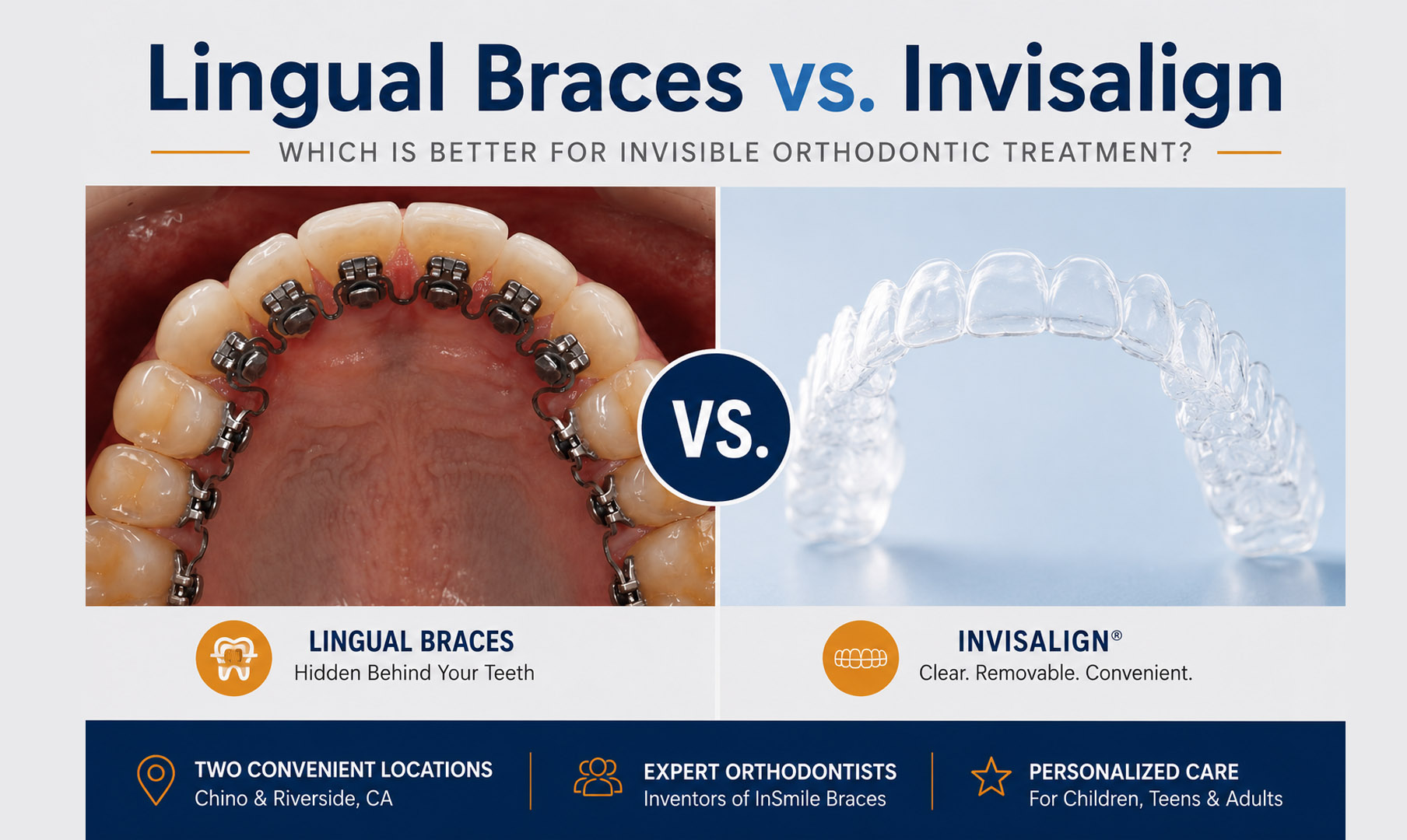
Lingual Braces vs. Invisalign®: Which Is Better for Invisible Orthodontic Treatment?
If you want straighter teeth without the appearance of traditional braces, you have more options today than ever before. Two of the most popular discreet orthodontic treatments are lingual braces and clear aligners such as Invisalign.
Both can straighten your teeth while keeping orthodontic treatment much less noticeable, but they accomplish that goal in very different ways. Clear aligners use a series of removable, transparent trays that fit over your teeth. Lingual braces use brackets and wires like traditional braces, but everything is placed behind the teeth, where it remains hidden from view.
So which is better? The answer depends on your teeth, bite, lifestyle, and personal preferences. Here’s what you should know when comparing lingual braces vs. Invisalign.
What Are Lingual Braces?
Lingual braces are fixed orthodontic braces placed on the inside, or tongue side, of your teeth. Because the brackets and wires sit behind the teeth rather than on the front, they’re virtually invisible when you smile, giving you the benefits of fixed orthodontic treatment without visible brackets across the front of your teeth.
At BigSmile Orthodontics, our customized lingual treatment option is InSmile Braces. InSmile uses custom-designed brackets and Smartwire® appliances created specifically for each patient’s teeth and treatment plan, providing precise orthodontic tooth movement while keeping the appliance hidden behind your smile.
What Is Invisalign?
Invisalign is a clear aligner system that uses a sequence of removable plastic trays to gradually move your teeth. Rather than brackets and wires, you change to new aligners periodically as your teeth progress through treatment.
Clear aligners are popular because they’re discreet and removable. You can take them out while eating, brushing, and flossing. However, that removability also means the patient is responsible for wearing the aligners consistently. For treatment to progress as planned, clear aligners generally need to be worn approximately 20 to 22 hours per day.
Lingual Braces vs. Invisalign: What’s the Biggest Difference?
The fundamental difference is simple: lingual braces are fixed, Invisalign is removable.
With InSmile lingual braces, your appliance stays attached to your teeth and continues working throughout the day and night. With Invisalign, you’re responsible for wearing your aligners consistently and changing them according to your orthodontist’s instructions.
Neither approach is inherently better. Some patients love the freedom of removing their aligners. Others prefer not having to think about wearing their orthodontic appliance at all.
Which Is More Invisible?
Both treatments are extremely discreet, but in different ways.
Invisalign trays are made from clear plastic, so they’re much less noticeable than traditional braces. However, the aligners still cover the visible surfaces of your teeth, and many patients require tooth-colored attachments that may be noticeable at close distances.
Lingual braces take a different approach. Instead of making the appliance clear, they hide it behind your teeth, so when you smile, the brackets and wires generally can’t be seen at all. For patients whose highest priority is keeping their orthodontic appliance out of sight, lingual braces offer a unique advantage.
Which Requires Less Patient Compliance?
This is one of the biggest differences between the two treatments. Invisalign works extremely well when aligners are worn as directed, but every time the trays are removed, treatment temporarily stops. Patients need to remember to:
- Wear their aligners approximately 20 to 22 hours per day
- Remove them before eating
- Put them back in after meals
- Keep track of their aligners
- Change to new aligners according to schedule
For responsible patients, this routine may be easy. For others, especially busy adults or teenagers, compliance can become one of the biggest challenges with clear aligner treatment.
InSmile Braces eliminate that concern because the appliance stays attached to your teeth. There are no trays to remember, lose, or forget to put back in. Your braces are always there and always working.
Which Is Easier for Eating?
This comparison is more of a tradeoff.
With Invisalign, there are generally very few food restrictions because you remove your aligners before eating, though you need to take the trays out for meals and snacks and ideally clean your teeth before putting them back in.
With lingual braces, there’s nothing to remove before eating, so you can simply eat with your braces in place. However, as with traditional braces, you’ll need to avoid very hard, sticky, or chewy foods that could damage the appliance.
Patients who enjoy being able to eat almost anything may prefer clear aligners. Patients who don’t want to constantly remove and replace trays may prefer InSmile.
Which Is Easier to Keep Clean?
Clear aligners have an advantage when it comes to brushing and flossing because the trays can be completely removed. You can brush and floss normally and then clean your aligners separately.
Lingual braces require additional attention because brackets and wires remain attached behind your teeth. You’ll need to carefully brush around the appliances and use appropriate flossing techniques or other cleaning aids. With good oral hygiene habits and proper instruction from your orthodontic team, however, patients can maintain excellent oral health with either treatment.
Do Lingual Braces or Invisalign Affect Speech?
There can be a short adjustment period with either option.
Because lingual braces are positioned near your tongue, some patients notice changes in their speech or a slight lisp when treatment begins, though your tongue typically adapts as you become accustomed to the appliance. Clear aligners can also temporarily affect speech because the plastic trays cover the teeth. For most patients, speech changes with either treatment are temporary and improve as they adapt.
Which Is More Comfortable?
Both treatments require an adjustment period because orthodontic treatment works by applying forces to move your teeth.
With Invisalign, patients may experience pressure or soreness when changing to a new set of aligners. With lingual braces, the teeth may feel sore after treatment begins or following certain adjustments, and your tongue also needs time to become accustomed to having an appliance behind the teeth. Modern customized lingual systems such as InSmile have been designed with smaller, smoother components to improve the patient experience compared with earlier generations of lingual braces.
Which Can Treat More Complex Orthodontic Problems?
Both clear aligners and lingual braces have become significantly more advanced and can treat a wide variety of orthodontic problems, including crowding, spacing, rotated teeth, overbites, underbites, crossbites, open bites, and relapse after previous orthodontic treatment.
Some tooth movements or bite corrections may be easier to accomplish with fixed appliances, while other cases are excellent candidates for clear aligners. This is one reason choosing an experienced orthodontist matters. Rather than deciding on an appliance first, your orthodontist should diagnose your orthodontic problem and determine which treatment options can predictably achieve your goals.
Are Lingual Braces Better for Adults?
Not necessarily, but they offer several advantages that many adults appreciate.
Professionals often choose lingual braces because the appliance stays completely behind their teeth. There are no trays to remove during business lunches, presentations, social events, or meetings, and you don’t have to think about reaching the required number of aligner wear hours every day.
On the other hand, some adults love Invisalign precisely because the trays are removable and brushing and flossing remain simple. The better choice depends on which advantages matter most to you.
What About Teenagers?
Both options can work very well for teenagers.
Clear aligners may be an excellent choice for teens who are responsible about wearing and keeping track of their trays. Lingual braces can be particularly appealing for teenagers who don’t want visible braces but whose parents would rather not depend on consistent aligner wear. Because InSmile stays attached to the teeth, parents don’t have to ask, “Are you wearing your aligners?”
So, Which Is Better: Lingual Braces or Invisalign?
There isn’t one answer for everyone.
You may prefer Invisalign if you:
- Want a removable orthodontic appliance
- Prefer fewer food restrictions
- Want to brush and floss without brackets or wires
- Are confident you can consistently wear your aligners as directed
You may prefer InSmile lingual braces if you:
- Want braces that are completely hidden behind your teeth
- Don’t want to worry about daily aligner wear
- Prefer treatment that remains in place around the clock
- Don’t want to remove an appliance every time you eat
- Want the benefits of a customized fixed orthodontic system
Ultimately, the best treatment is the one that can achieve your orthodontic goals while fitting your lifestyle.
InSmile Expertise at BigSmile Orthodontics
If you’re considering lingual braces, experience matters, and BigSmile Orthodontics has a unique connection to the development of modern customized lingual orthodontics.
Dr. Hongsheng Tong is the main inventor of InSmile Braces and co-founder of the original company that developed the technology previously known as InBrace. He served as the company’s original Chief Technology Officer and Chief Medical Officer and later as Principal Orthodontic Scientist. Today, he continues to serve as a Clinical Advisor for InSmile and teaches InSmile and lingual orthodontics as a Clinical Assistant Professor at USC.
Many of the earliest patients ever treated with the technology received their care at BigSmile’s Chino and Riverside offices, which we proudly consider the Birthplace of InSmile Braces.
BigSmile is also home to Dr. Robert Lee, a co-inventor of the technology and current Chief Medical Officer of InSmile Braces. Together, Dr. Tong and Dr. Lee provide BigSmile patients with a level of firsthand experience with InSmile and customized lingual orthodontics that’s difficult to find elsewhere.
Find the Right Invisible Orthodontic Treatment for Your Smile
You don’t have to choose between visible braces and a straighter smile. Both InSmile lingual braces and clear aligners provide discreet alternatives to traditional braces, and each has advantages depending on your orthodontic needs and lifestyle.
At BigSmile Orthodontics, we offer multiple treatment options rather than trying to fit every patient into the same appliance. Schedule a complimentary consultation at our Chino or Riverside orthodontic offices to learn whether InSmile Braces, clear aligners, or another treatment option is right for you.